
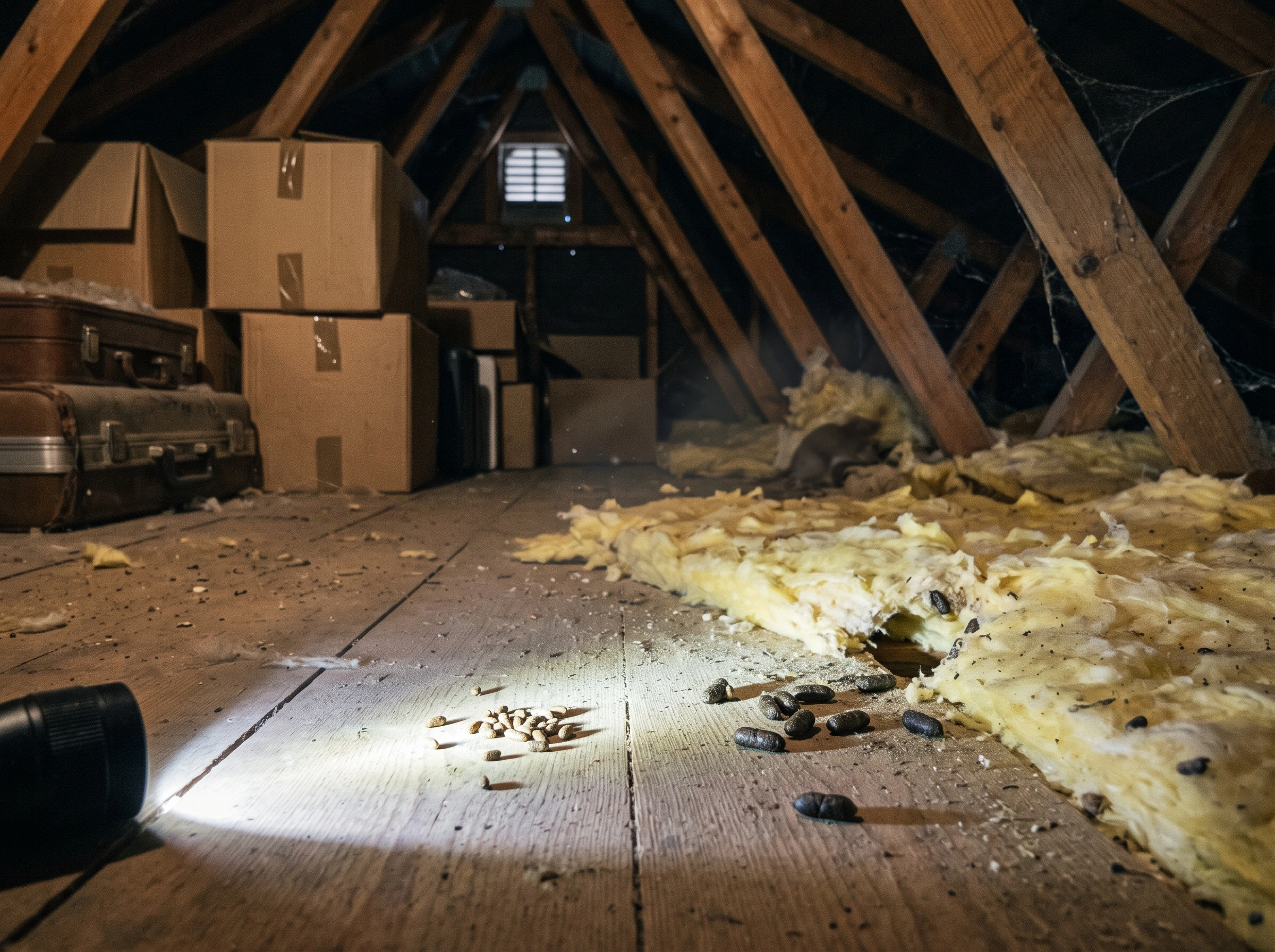
Finding an unexpected guest in your attic can be a nightmare. Before you can tackle the problem, you need to identify exactly who has moved in. Since you likely won’t see these nocturnal intruders face-to-face, you’ll have to play detective using the two most common clues they leave behind: droppings and noises.
Here is a guide to identifying the most common culprits in British lofts.
The Common House Mouse
Mice are the most frequent attic invaders. Because of their size, they can squeeze through gaps as small as a pencil.
The Noises
- Sound: Soft scratching and skittering.
- Timing: Almost exclusively at night.
- Location: You’ll hear them moving across the ceiling or inside wall cavities. Because they are light, the sound is often described as a patter rather than a thump.
The Droppings
- Size: Small, roughly 3–8mm long (about the size of a grain of rice).
- Shape: Spindle-shaped with pointed ends.
- Colour: Dark brown or black when fresh, turning grey and crumbly when old.
- Quantity: They are prolific poopers; a single mouse can drop up to 80 pellets a day, usually scattered randomly.

The Brown Rat
Rats are larger, heavier, and significantly more destructive than mice. If a rat is in your loft, you’ll likely know about it pretty quickly.
The Noises
- Sound: Loud gnawing, thumping, and rhythmic scurrying.
- Distinction: You can often hear the weight of a rat as it moves. You might also hear bruxing, a grinding sound made by their teeth.
The Droppings
- Size: Large, roughly 15–20mm long (about the size of an olive stone).
- Shape: Capsule-shaped with blunt, rounded ends.
- Colour: Dark, often shiny when fresh. Unlike mice, rats tend to latrine, meaning you’ll find clusters of droppings in specific corners rather than a trail.

The Grey Squirrel
While technically a rodent, the squirrel’s habits differ significantly from those of mice and rats. They use lofts primarily for nesting (dreys) and warmth.
The Noises
- Sound: Very loud scratching, rolling sounds (often acorns or walnuts being moved), and vocal chirping.
- Timing: Diurnal. This is the biggest giveaway. If you hear frantic activity at dawn and dusk, it’s almost certainly a squirrel. If the noise is at 2:00 AM, it’s likely a rat or mouse.
The Droppings
- Size: Similar to a rat, roughly 8–12mm.
- Shape: More rounded or spherical than rat droppings.
- Texture: They may look woody or contain visible bits of undigested nuts or seeds. They darken over time but don’t crumble as easily as mouse droppings.
A Note on Safety
If you are heading into the loft to investigate, please take the following precautions:
- Wear a Mask: Rodent droppings can carry respiratory diseases (like Hantavirus), which can be inhaled if dust is disturbed.
- Gloves are Essential: Never touch droppings with bare hands.
- Check the Wiring: Rodents love to chew plastic insulation. If you find evidence of an infestation, check your loft’s electrical cables for fire hazards.
Contact Willis Pest Control
At Willis Pest Control, we provide expert pest control solutions across Birmingham and the Midlands. For help with pest control, please do not hesitate to contact our expert Willis Pest Control team; call us at 0121 588 5258 or 07305 518033.


